
Table Of Contents
Every country has a landmark that tells its story at a single glance.
For the United States, that landmark is Mount Rushmore.
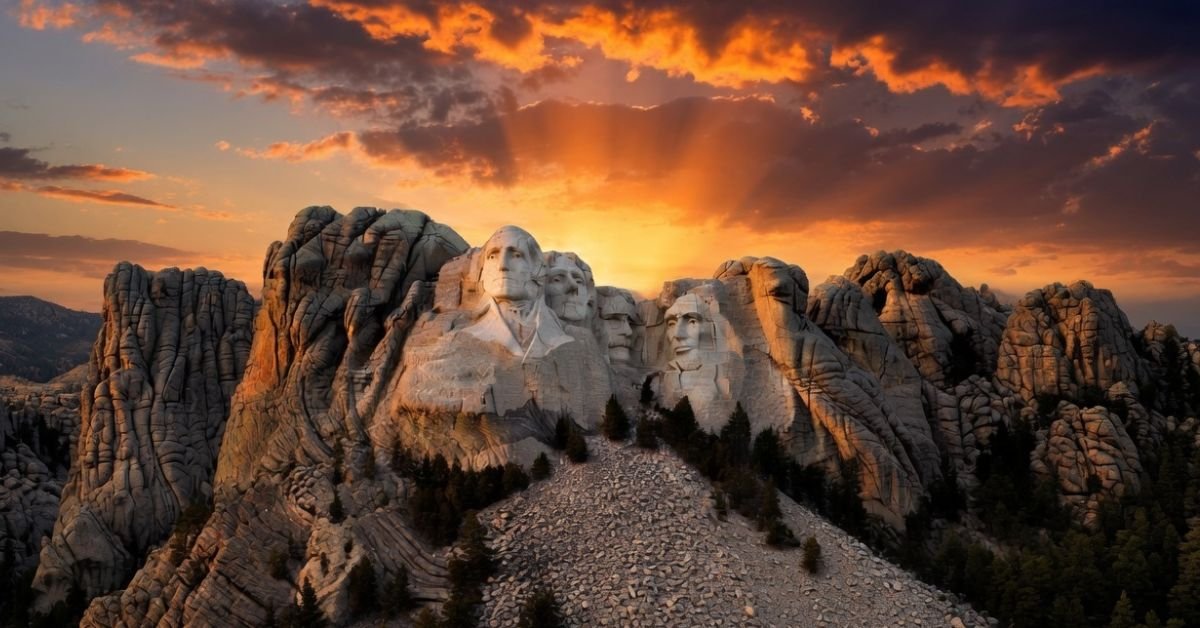
Four presidential faces gaze out from a granite mountain in the Black Hills of South Dakota.
Each face stands about 60 feet tall.
Together, they represent the birth, growth, development, and preservation of a nation.
The memorial returned to the global spotlight when it hosted one of the headline celebrations for America’s 250th birthday in 2026.
However, long after any anniversary fades, the questions people ask about this mountain remain the same.
Where did the idea come from?
Who carved it?
Why these four presidents?
Moreover, what should you know before you visit?
When our travel desk researched Black Hills itineraries, we noticed something interesting.
Most visitors spend less than an hour at Mount Rushmore because they treat it as a photo stop.
Those who know the story behind the stone stay for half a day.
This article is for the second kind of traveler.
Let us dig in.
What Is Mount Rushmore?
Mount Rushmore National Memorial is a massive sculpture carved into a granite mountainside near Keystone, South Dakota.
It features the faces of four American presidents: George Washington, Thomas Jefferson, Theodore Roosevelt, and Abraham Lincoln.
The memorial covers about 1,278 acres and sits roughly 5,700 feet above sea level.
The National Park Service manages it and welcomes more than two million visitors every year.
Here is a detail many people miss.
The mountain was named long before the carving began. It took its name from Charles E. Rushmore, a New York lawyer who visited the Black Hills in 1885 to inspect mining claims.
He asked a local guide what the mountain was called. The guide reportedly joked that it had no name, so they might as well call it Rushmore.
The name stuck.
The Story Behind the Carving
The idea began in 1923 with a South Dakota historian named Doane Robinson.
He wanted a giant attraction that would draw tourists into his state.
Robinson originally imagined carvings of Western heroes such as Lewis and Clark, Red Cloud, and Buffalo Bill Cody.
The sculptor he approached had a much bigger vision.
That sculptor was Gutzon Borglum. He believed the monument should speak to the entire nation, not just one region.
So he proposed carving presidents instead of regional figures.
Carving began on October 4, 1927.
It ended on October 31, 1941, shortly after Borglum passed away.
His son, Lincoln Borglum, supervised the final stage of the work.
The project officially spanned 14 years, but the National Park Service notes that actual carving happened during only about six and a half of those years.
Harsh winters and repeated funding gaps stopped work again and again.
The numbers are still staggering.
Nearly 400 workers shaped the mountain.
According to the National Park Service, about 90 percent of the carving was done with dynamite, and workers removed roughly 450,000 tons of rock.
The total cost came to just under one million dollars, an enormous sum during the Great Depression.
One more remarkable fact deserves careful wording.
No worker died in an accident on the mountain during the carving, which is extraordinary given that men hung from cables while setting explosives on a cliff face.
Some workers did suffer later in life from silicosis, a lung disease caused by breathing rock dust, and several deaths in later decades have been attributed to it. Both parts of that story deserve to be remembered.
Why These Four Presidents?
Borglum did not choose the four faces at random.
Each president was selected to represent a specific chapter in the American story.
| President | Term In Office | What He Represents |
|---|---|---|
| George Washington | 1789 to 1797 | The birth of the nation |
| Thomas Jefferson | 1801 to 1809 | The growth and expansion of the nation |
| Theodore Roosevelt | 1901 to 1909 | The development of the nation |
| Abraham Lincoln | 1861 to 1865 | The preservation of the nation |
Washington led the fight for independence and became the first president.
His face was completed first and dedicated in 1934.
Jefferson wrote the Declaration of Independence and doubled the size of the country through the Louisiana Purchase.
His face also carries the project’s most dramatic backstory.
Workers originally began carving Jefferson on Washington’s right side.
After about 18 months, the rock there proved too weak and cracked.
The entire unfinished face was blasted off the mountain with dynamite, and Jefferson was carved again on the left.
Roosevelt championed the construction of the Panama Canal and fought for ordinary workers and consumers.
He was also a passionate conservationist who protected millions of acres of American land.
Lincoln held the country together through the Civil War and ended slavery.
His face was dedicated in 1937.
The Unfinished Vision
Most visitors do not realize that Mount Rushmore was never actually finished.
Borglum’s original plan depicted the presidents from the head to the waist.
He also designed a Hall of Records, a grand room carved into the canyon behind the faces.
It was meant to store America’s most important documents, including the Declaration of Independence and the Constitution.
Funding ran out, and the United States entered World War II shortly after the carving stopped.
The waist-level design was abandoned, and the Hall of Records was left as a rough tunnel.
In 1998, the story received a quiet ending.
Officials placed a titanium vault inside the unfinished hall.
The vault holds sixteen porcelain panels that record the history of the memorial, the reasons the four presidents were chosen, and a brief history of the United States. It is sealed inside the mountain for future generations to discover.
Could a fifth face ever join the four? Engineers and geologists have repeatedly concluded that the remaining rock is not stable enough to support new carving, and the National Park Service considers the sculpture a completed work of art.
The four faces are likely to remain exactly as they are.
The Black Hills and the Lakota
A complete history of Mount Rushmore must include the land itself.
The Black Hills are sacred to the Lakota Sioux, who know the region as Paha Sapa.
The United States government recognized the area as Lakota territory under the Treaty of Fort Laramie in 1868.
After gold was discovered in the 1870s, the land was taken.
In 1980, the United States Supreme Court ruled that the seizure was unlawful and awarded financial compensation.
The Lakota have refused the money, which has grown with interest to well over a billion dollars, because they believe the land itself should be returned.
This is also why the Crazy Horse Memorial, a mountain carving honoring the famous Lakota leader, has been under construction just 17 miles away since 1948.
Many travelers visit both monuments on the same day, and the two carvings together tell a far richer story than either one alone.
Visiting Mount Rushmore: A Quick Guide
Planning a trip?
Here are the essentials.
The memorial is open every day of the year except December 25.
Entrance is free.
Vehicles pay a parking fee, currently 10 dollars per car and valid for a full year, though it is worth confirming the latest rate on the official National Park Service website before you go.
The best months to visit are May through October, when the weather is mild, and all facilities are open.
The popular evening lighting ceremony in the amphitheater runs seasonally, roughly from late May through September, so check the schedule if that moment is on your list.
Give yourself two to four hours.
Walk the Presidential Trail, a short loop that brings you surprisingly close to the base of the mountain.
Visit the Sculptor’s Studio to see Borglum’s original models and tools.
Moreover, take your time on the Avenue of Flags, where the flags of all states and territories line the walkway toward the viewing terrace.
One honest tip from our research: the classic head-on view gets crowded by mid-morning in summer.
Arriving before 8 a.m. rewards you with soft light on the faces and space to enjoy them in relative quiet.
The nearest airport is in Rapid City, about 35 minutes away by car.
Many travelers combine the trip with Custer State Park, Badlands National Park, and the Crazy Horse Memorial.
Trivia Corner: Facts That Surprise Almost Everyone
Every good story deserves a few surprises.
Mount Rushmore has plenty.
The presidents have 20-foot noses.
Each eye is about 11 feet wide, and each mouth roughly 18 feet across, with Washington’s nose measuring slightly longer than the others, according to National Park Service figures.
The eyes have a hidden trick. Borglum carved a shaft of granite inside each pupil.
The protruding post catches sunlight, creating the illusion of a lifelike sparkle in the president’s eyes.
The faces erode at a glacial pace.
Geologists estimate the granite wears down about one inch every 10,000 years, and Borglum deliberately added extra stone to key features so the sculpture could endure for thousands of years.
A famous movie scene was filmed nowhere near it.
The thrilling chase across the faces in Alfred Hitchcock’s classic North by Northwest was shot on a studio set because authorities refused permission to film on the monument itself.
Workers climbed 700 stairs every morning. Before a full day of drilling and blasting, the carvers first climbed from the base to the top of the mountain on foot.
Frequently Asked Questions
Who carved Mount Rushmore?
Sculptor Gutzon Borglum designed and led the project. After his death in March 1941, his son Lincoln Borglum completed the remaining work.
How long did it take to carve Mount Rushmore?
The project ran from 1927 to 1941, though actual carving took place for only about six and a half of those years due to weather and funding interruptions.
Can a fifth face be added to Mount Rushmore?
Experts say no. The remaining rock is not structurally suitable for carving, and the National Park Service considers the memorial a finished work of art.
How much does it cost to visit?
Entry is free. Visitors pay only a vehicle parking fee, currently 10 dollars per car, which remains valid for a full year.
What is the best time to visit Mount Rushmore?
Late May through September offers the mildest weather, full facilities, and the evening lighting ceremony. Early mornings are the quietest.
Final Thoughts
Mount Rushmore is more than a photo stop. It is a story of bold ambition, brilliant engineering, national identity, and contested history, all carved into a single mountain.
The four granite faces have watched over the Black Hills for more than eight decades, and they will keep watching long after every anniversary celebration is forgotten.
If you enjoyed this deep dive, you will find plenty more on our site, including our guides to America’s national parks, landmark histories from around the world, and practical travel planning tips.
We would love to have you back.
About Author
