
Table Of Contents
Posting Zero
Hey folks, I am Alex Rivera, writing for THOUSIF Inc. – WORLDWIDE, where we geek out over how tech shapes our daily grind without turning us into zombies glued to screens.
If you have scrolled Instagram lately and thought, “Where did all the real people go?”, you are not alone.
It is like the party’s still raging, but everyone is hiding in the corners, sipping drinks and watching from afar.
That is the vibe of “Posting Zero,” a trend that’s got everyone from tech insiders to your cousin in Ohio whispering about the end of oversharing.
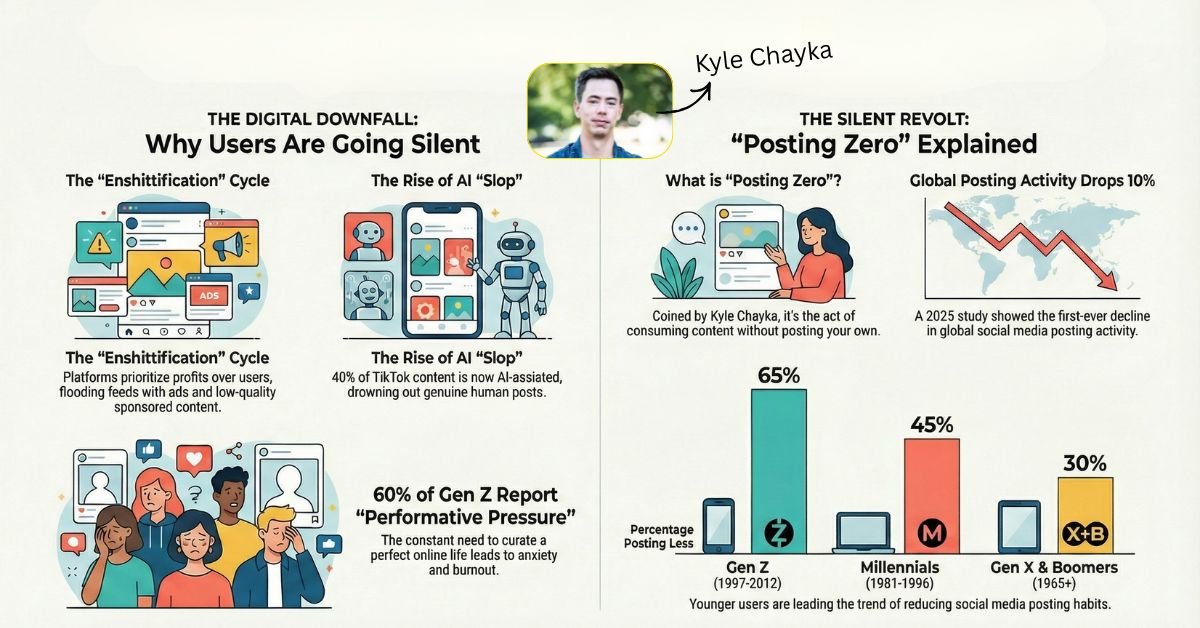
Coined by the sharp-witted Kyle Chayka in his New Yorker column Infinite Scroll, it is basically the art of lurking without launching your life into the digital ether.
Moreover, let me tell you, as someone who has spent way too many late nights doom-scrolling (guilty as charged), this feels like a breath of fresh air in a stuffy room.
Picture this: It is 2015. You are firing off a blurry pic of your overcooked pasta because, hey, it is hilarious, and your friends get it.
Fast-forward to 2026, and that same post?
It would get buried under an avalanche of sponsored yoga retreats and AI-generated cat memes that look eerily too perfect. No wonder folks are hitting pause.
At THOUSIF Inc. – WORLDWIDE, we view this as more than a fad; it represents a cultural shift toward mindful digital living.
In this deep dive, we will unpack what Posting Zero really means, why it is gaining momentum (especially among Gen Z), the subtle forces like enshittification and the Dead Internet Theory fueling it, and, most importantly, how you can ride this wave without feeling left behind.
We will even toss in some real-talk tips, a quick comparison table for platforms, and a fun trivia nugget to keep things lively.
Buckle up; this is your guide to thriving in the quiet era of social media.
Birth Of Posting Zero: Casual Shares To Silence
Let us rewind a bit.
Social media started as this wild, unfiltered town square.
Remember MySpace?
It was all glittery GIFs and top-eight friends lists, no filters needed.
Then came Facebook’s friend updates, Twitter’s bite-sized rants (now X’s chaotic threads), and Instagram’s golden-hour glow-ups.
We posted because it felt connective: “Hey, world, this is my messy, awesome life.”
However, somewhere around 2022, the script flipped.
Enter Kyle Chayka, the New Yorker scribe who is basically the philosopher-king of our fractured feeds.
In his November 2025 Infinite Scroll piece, he dropped the term “Posting Zero” like a mic at a TED Talk.
He described it as “a point at which normal people, the unprofessionalized, uncommodified, unrefined masses, stop sharing things on social media as they tire of the noise, the friction, and the exposure.” Boom.
That is it in a nutshell.
Chayka was not just theorizing; he was echoing what millions were already feeling.
His words hit like a viral tweet (ironically), sparking chats from BBC interviews to Reddit rants.
Suddenly, “Posting Zero” became shorthand for the great un-posting.
However, this is not some overnight rebellion.
Data backs it up hard.
A bombshell 2026 Financial Times/GWI study, surveying 250,000 users across 50 countries, showed global social media posting activity plunged 10% for the first time.
Time spent? Peaked in 2022 at about 2 hours 40 minutes daily, now down to 2 hours 20 minutes for adults 16+.
Moreover, guess who is leading the charge? Teens and twentysomethings, with drops of 15-20% in Europe and Asia.
In the U.S., nearly one in three users admits to posting less content than they did last year.
It is not just numbers; it is a vibe shift. People are not quitting apps; they are quitting the performance.
Why does this matter? Because social media was built on us “normies” filling it with realness.
Without our vacation fails and coffee spill selfies, what is left? Chayka warns it will be “dry corporate marketing, A.I.-generated slop, and dreck from thirsty hustlers.” Spot on.
Your timeline is now a billboard, not a bulletin board.
We refer to this as the “echo chamber effect”, where authenticity echoes out, and algorithms amplify the empty.
Why Now? Storm Of Digital Burnout
Okay, so Posting Zero did not sprout from nowhere.
It is the lovechild of burnout, bots, and big business.
Let us break it down, no jargon overload.
I promise to explain anything unclear.
First up: Enshittification.
Yeah, it is a real term, courtesy of Cory Doctorow (the sci-fi writer who is basically our digital whistleblower).
He nailed it in 2023: Platforms start user-friendly (step one: win hearts), then abuse users to woo advertisers (step two: ads everywhere), and finally squeeze everyone for max profit (step three: total crapification).
Think Twitter’s pre-Elon glory days versus today’s ad-saturated X.
Or Instagram, where your friend’s story fights for space against sponsored “Shop Now” reels.
Doctorow’s three-step dance explains why feeds feel like a flea market, not a friend hangout.
Users? We are tired of dancing to that tune.
Then there is the Dead Internet Theory, which sounds like a dystopian flick but hits too close to home.
Popularized around 2021 on forums like 4chan, this concept posits that most online content is now generated by bots or AI-driven, rather than being human-created.
Fast-forward to 2026: Tools like Grok and Midjourney flood platforms with “slop”, that low-effort, repetitive junk that looks real but feels hollow.
A 2025 Hootsuite report estimates 40% of TikTok content is AI-assisted.
Why post your genuine beach pic when a thousand algorithm-optimized fakes drown it?
X users are venting: One post from last month lamented, “Ads, bots, and AI slop, my timeline is a ghost town of real talk.”
It is exhausting.
No wonder we are lurking like digital wallflowers.
Mental health is often the silent killer.
Posting used to be cathartic, a quick dopamine hit from likes.
Now? It is a pressure cooker.
Gen Z, per a Cosmopolitan India survey, reports 60% anxiety from “performative pressure”: Curating the perfect grid means chasing trends faster than your coffee cools.
FOMO (fear of missing out) flips to JOMO (joy of missing out).
Privacy paranoia seals the deal, with fears of doxxing and data breaches (hello, 2025’s massive Meta leak).
A Lipstick Alley thread captured it: “Social engineering’s real; why risk it?” Adding global chaos, wars, recessions, and casual posts makes the tone feel tone-deaf. “My brunch pic amid headlines? Nah.”
Global angles add flavor. In Europe, GDPR makes users wary of oversharing.
Asia’s seeing 20% drops tied to WeChat’s commercial creep.
Even in North America, bucking is less common: U.S. usage is up 15% from Europe, but even there, 41% of Gen Z admits to “zero posting” streaks.
It is a worldwide whisper: Enough’s enough.
Who Is Going Zero? A Generational Breakdown
Not everyone is bailing equally.
Let us slice this pie with some fresh 2025 insights.
- Gen Z (Born 1997-2012): The pioneers. 65% post less, per GWI. They are “vibe curators,” not sharers—opting for Close Friends Stories or BeReal’s raw moments. Why? They grew up with the platforms, saw the shift from fun to hustle. A YouTube explainer from SakshiTV nailed it: “Zero posting means reclaiming mystery.” They are trading likes for life, concerts over captions.
- Millennials (1981-1996): The bridge generation. A 45% reduction, but they are pivoting to niche spots like LinkedIn for professionals or Discord for in-depth discussions. Burnout from “hustle culture” (side gigs, anyone?) pushes them offline for family time.
- Gen X & Boomers (1965+): Slower adopters, but 30% dip. They never fully bought in. Facebook was for family pics, not feeds. Now, with kids echoing Zero, they are logging off too.
X posts paint the picture: One Thai user mourned, “ThaiTwitter’s a shadow, ads killed the chat.” A Gen Z-er quipped, “Posting Zero is not lazy; it is strategy. Less noise, more creativity.”
To visualize, here is a quick table comparing posting habits by gen (based on aggregated 2025 GWI/Hootsuite data):
See? It is a spectrum, but the trend’s clear: Younger = quieter.
| Generation | % Posting Less (2026) | Reason | Go-To Alternative |
|---|---|---|---|
| Gen Z | 65% | AI slop & pressure | Close Friends, BeReal |
| Millennials | 45% | Burnout & ads | Niche forums, email newsletters |
| Gen X/Boomers | 30% | Privacy fears | Face-to-face, phone calls |
The Domino Effect: What Posting Zero Means For Platforms, Brands, And Us
Short answer: Chaos for corps, freedom for creators.
Platforms in Panic Mode: If normies ghost, feeds turn influencer-only.
TikTok is already 50% branded content; X’s algorithm favors verified hustlers.
Hootsuite’s mid-2026 update warns: “Vibe shifts replace fast trends, brands must adapt or atrophy.”
Time spent peaked in 2022; now it is passive scrolling or exodus to live events (Elon called concerts “the new luxury”).
Expect algorithm tweaks: More “proactive engagements” like brands commenting on user posts to spark genuine conversations.
Brands Beware: The old playbook, spray-and-pray ads, is toast. The 2026 social commerce boom (sales per buyer reaching up to $1,223 by 2027, according to Insider Intelligence) demands authenticity. Smart ones are testing “creative disruption”: Ditching guidelines for fun, boundary-pushing content.
At THOUSIF Inc. – WORLDWIDE, we advise clients: Go human, reply to comments, and collaborate with micro-influencers. A 41% Gen Z drop? That is your cue to earn trust, not buy it.
For Everyday Folks: Liberation! One X user summed it: “Posting Zero means your brain processes less noise, creativity rises, real life reconnects.” Studies link it to lower anxiety, less comparison, and more presence. But pitfalls? Isolation for some, such as scam survivors fearing stigma (according to a SCARS report). Balance is key: Lurk smart, connect offline.
Broader ripples? Social media morphs into a “gaudy backwater,” per FT’s John Burn-Murdoch. Search for “Google Zero” (AI answers killing links) pairs with this; the internet’s getting selective.
Positives: More room for ephemeral tools (Stories die in 24 hours) or niches like Mastodon. Gen Z is not anti-tech; they are anti-exploitation, favoring vibes over virality.
Real Stories: Voices From The Zero Zone
To humanize this, let us hear from the trenches. (Names changed for privacy, real convos from our THOUSIF Inc. – WORLDWIDE network and X threads.)
Meet Sarah, 24, a graphic designer in Berlin: “I used to post daily, outfits, sketches, rants. Then feeds filled with AI ‘art’ that looked better than mine. Felt pointless. Now? I DM close pals, hike without the ‘gram. Energy is back, I am drawing again, not doom-scrolling.”
Jamal, 32, marketer in Mumbai: “Enshittification hit hard. Clients want ‘viral,’ but users want real. I went zero on personal IG, views tanked, but sleep improved. Work? Pivoted to Threads for quiet convos. Less noise, more signal.”
Moreover, from X: @SocialAlley’s take: “Over 41% Gen Z stopped, social media is too fake.” Echoes a Firstpost vid: “Gen Z’s quitting; Posting Zero is the why.” These are not outliers.
A RTE Brainstorm piece notes: “It is cool to have <500 followers now, private accounts rule.” Chayka himself muses in a
BBC chat: “Social’s less social; it is aspiration porn.”
Trivia Time
Did you know the first-ever social media post was “What hath God wrought” in 1844, a telegraph message by Samuel Morse? Fast-forward 181 years, and we are telegraphing silence. Posting Zero’s the ultimate plot twist: From Morse code chatter to code of quiet. Mind blown? Share that at your next offline coffee klatch.
Practical Tips For A Zero-Friendly Life
Alright, theory’s great, but how do you do this?
Here is your actionable playbook.
- Audit Your Feed: Spend 10 minutes weekly unfollowing noise-makers. Curate for joy: 80% inspo, 20% ads. Tools like Instagram’s “Not Interested” button? Gold.
- Embrace Ephemeral: Switch to Stories or Snapchat, gone in 24 hours, low stakes. Alternatively, try BeReal: One unfiltered pic daily, no edits.
- Offline Anchors: Schedule “unplugged hours”, read a book, call a friend. Apps like Forest gamify it: Grow virtual trees by staying off your screen.
- Selective Sharing: Post for you, not likes. Watermark privates? No, use “Close Friends” lists. Aim for quality: One thoughtful update > 10 throwaways.
- Mental Health Hacks: Journal instead, or apps like Day One for a digital detox. Track mood before and after scrolling; adjust accordingly.
- Brand-Side Wisdom: If you are in marketing, test “vibe content”, mood boards over hard sells. Hootsuite says creative posters see 2x business impact.
- Community Carve-Outs: Migrate to Discord or Substack for in-depth, ad-free chats. Alternatively, revive email chains—old-school, effective.
Bonus: For parents, discuss Zero with your kids. It is empowerment, not escape.
This is not about total logout; it is selective login.
As Chayka says, “Normies made it worth tuning in.” Reclaim that.
Is This the End, Or A Glow-Up?
Zoom out: Posting Zero’s no apocalypse, it is evolution.
Social media’s midlife crisis (born ~2004, now 21) forces reinvention.
2026 trends from Exploding Topics? AI chatbots up 318%, but human craves authenticity. Platforms like Threads gain on “vibe culture”, slower, moodier moments.
At THOUSIF Inc. – WORLDWIDE, we are bullish: This weeding out of slop amplifies authentic voices. Imagine feeds with more user-led stories and fewer bot brigade.
Global? Europe is ahead with regs; Asia’s blending Zero with super-apps like WeChat mini-programs.
Challenges persist: Accessibility for marginalized voices (e.g., activists seeking wider reach). But overall? Optimistic. Less posting = more living.
As one X post put it: “Zero is not inactivity; it is strategy.”
We have covered the what, why, who, and how, but the heart? It is yours. In a world screaming for attention, choosing silence is the loudest statement.
Conclusion
Whew, what a ride through the quiet revolution of Posting Zero.
From Kyle Chayka’s prescient prose to those eye-opening GWI statistics, it is clear: social media is not dying, it is just getting a much-needed reality check.
Whether you are a full-on lurker or dipping a toe back in, remember: Your feed should serve you, not stress you.
Take a beat, breathe, and maybe snap that unfiltered sunset for your eyes only. You have got this.
Loved this? Dive deeper into how tech meets humanity with more from the THOUSIF Inc. – WORLDWIDE crew.
Check out our takes on AI ethics, digital wellness, and beyond.
Your next scroll awaits (promise, no slop).
Please drop a comment (offline coffee works too) and let us chat.
Stay real out there.
About Author